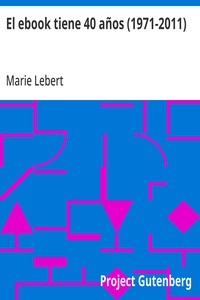
El ebook tiene 40 años (1971-2011) by Marie Lebert
Let's be honest: most of us think ebooks started with the Kindle or the iPad. Marie Lebert's fascinating book, 'El ebook tiene 40 años (1971-2011)', is here to gently correct us. It tells the true origin story, and it's way more interesting than you'd think.
The Story
Lebert doesn't just give us dates and specs. She introduces us to people. The story kicks off in 1971 with Michael Hart and Project Gutenberg. His big idea? To make important books free for everyone. The problem? Computers were the size of rooms, and 'everyone' meant a handful of researchers. The book then follows a four-decade relay race of inventors, tinkerers, and dreamers. We see the first clunky dedicated e-readers that nobody bought, the early debates about digital rights, and the quiet work of volunteers typing out entire books to build the first free digital libraries. The plot isn't about a single person, but about an idea—that books could be digital—and the collective, often stumbling, effort to make it a normal part of our lives.
Why You Should Read It
This book changed how I see my own shelves, both physical and digital. It's incredibly humbling. These pioneers worked for decades with little reward, driven purely by a belief in universal access to knowledge. Lebert makes you feel the excitement of their small victories and the frustration of their dead ends. You start to appreciate the ebook not as a corporate product, but as a cultural artifact that was fought for. It connects dots I never knew existed, showing how early online communities and even the birth of the internet itself were intertwined with the dream of digital text. It’s a powerful reminder that big changes often start with quiet, persistent passion.
Final Verdict
This is a must-read for curious book lovers and anyone interested in how our digital world was built, one page at a time. It's perfect for history buffs who enjoy stories of innovation, librarians and teachers who work with digital media, and readers who just love a good underdog tale. If you've ever been grateful for the convenience of carrying a thousand books in your bag, this is the origin story you didn't know you needed. It gives profound context to the simple act of tapping 'download.'
You are viewing a work that belongs to the global public domain. Access is open to everyone around the world.
Karen Harris
1 year agoBased on the summary, I decided to read it and it manages to explain difficult concepts in plain English. I would gladly recommend this title.
Kimberly Wright
3 months agoComprehensive and well-researched.
Daniel Lopez
1 year agoFrom the very first page, the flow of the text seems very fluid. A true masterpiece.
Christopher Johnson
2 months agoUsed this for my thesis, incredibly useful.