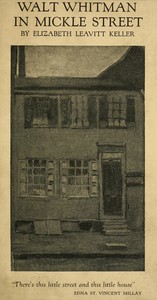
Walt Whitman in Mickle Street by Elizabeth Leavitt Keller
Elizabeth Leavitt Keller’s Walt Whitman in Mickle Street isn't a sweeping biography. It's a close-up, almost a snapshot, of the poet's final chapter. After a stroke in 1873, Whitman moved to a small, cluttered row house at 328 Mickle Street in Camden, New Jersey. This book is about life in that house.
The Story
Keller, who knew Whitman during this time, walks us through the door. We see the piles of books and papers, the simple furniture, and the famous poet, now elderly and frail, holding court. The plot is the daily rhythm of his existence. It's filled with a parade of characters: young admirers who treat him like a guru, busybody friends managing his affairs, curious journalists, and the occasional sincere helper. The central tension is quiet but constant. Whitman, the champion of the independent self, becomes a man who needs help. The book watches as people debate his care, edit his work, and jockey for position as his 'true' friend. Through it all, Whitman remains a complex figure—grateful, grumpy, sharp, and relentlessly himself, even as his body fails.
Why You Should Read It
I loved this because it makes a legend feel real. We're so used to seeing Whitman as this booming, healthy voice of America. Keller shows us the man who couldn't easily get out of his chair. It doesn't diminish his poetry; it makes the fact that he kept writing and revising Leaves of Grass from that little house even more powerful. Her perspective is unique—she’s close enough to see the details but clear-eyed about the sometimes awkward or difficult situations. You get the feeling she’s telling you the unvarnished truth, not building a statue. It changed how I read lines about the body and soul, knowing the physical struggle behind them.
Final Verdict
This is perfect for anyone who loves Whitman's poetry and wants to know the man behind it. It's also great for readers interested in the messy, unglamorous side of literary fame. If you enjoy biographies that focus on a specific, revealing period rather than a whole life, you'll find this gripping. It's a short, poignant look at how a life ends, and how an icon is cared for, fought over, and remembered by the people in his orbit.
This content is free to share and distribute. It is available for public use and education.